

Ocean Park, Maine – A Living Chautauqua Community
It began as a simple question: why not have a place by the sea where summer means more than just leisure—a place where the mind and spirit could flourish together? By 1884, reading circles inspired by the Chautauqua movement were already thriving across Maine. From Biddeford to Greenville, neighbors gathered by lamplight in church basements and parlors to read Homer, discuss Darwin, and wrestle with the moral questions posed by Phillips Brooks or Plutarch. These groups were part of a larger, nationwide effort to bring adult learning into living rooms and small-town meeting halls — evidence of a hunger for knowledge and a statewide appetite for intentional living.
In southern Maine, a group of Free Will Baptists, inspired by the Chautauqua idea, attended their 1880 General Conference at the Weirs in New Hampshire. There they asked, “Why may we not have a Weirs on the seacoast, where we may spend our vacations with profit to soul and body, and not be subject to the rowdyism common at seaside resorts, where many of us have spent the summer season?”
They formed a committee to find a location for this new haven. Their charge was to find “ … the best available grounds for a permanent Free-will Baptist encampment.” After scouting sites across coastal New England, they settled on a site in Old Orchard: 45 acres with ocean views, beach frontage, and rail access.
With the land purchased and the charter in hand, Ocean Park’s founders quickly set about creating a community grounded in faith, learning, and culture. They constructed buildings, laid out streets and lots, and developed a program schedule, and in just a few short months, they laid the groundwork—literally and figuratively—for a community designed to nourish both soul and society.
Even before the first streets were officially recorded, Ocean Park’s founders began carving out spaces that would embody the spirit of their new community. In February 1881, they began planning the Temple. They chose a typically Chautauquan octagonal design, popular for its modern efficiency and its symbolism of harmony between heaven and earth. By May they had selected a site – soon known as Temple Square – that would become the cultural and spiritual heart of Ocean Park.
Still, the Temple was just the beginning. When Sunday attendance outgrew the Temple’s capacity, tents were pitched. By 1902, the Association dedicated Porter Memorial Hall, honoring founder Rev. Ethan Porter. His widow, Susan, donated the stained-glass window above the entrance—a beautiful and lasting symbol of his devotion to the community.
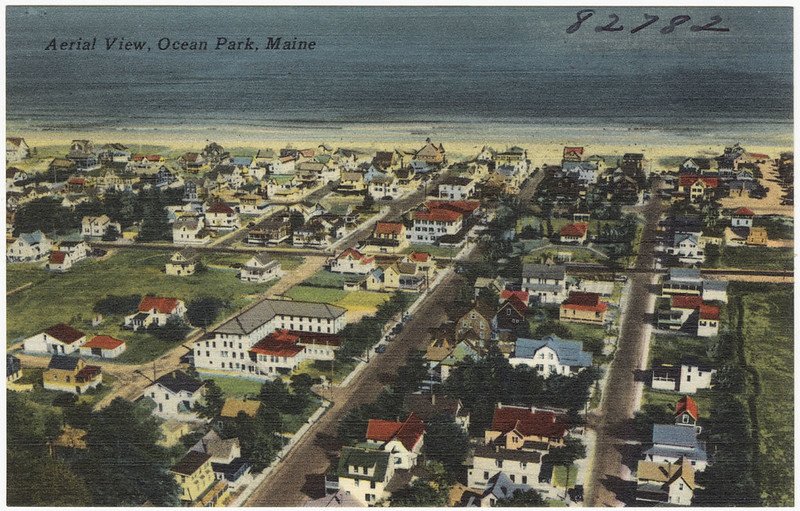
In June 1881, a street plan was recorded establishing the first four streets and three hundred lots for sale – for those who wanted Ocean Park to be a way of life, not just a seasonal retreat. The land was cleared and made ready for construction. By 1882, cottages stood on thirty lots. By 1895, another hundred had been sold.
Ocean Park is laid out along a roughly north-south axis, with rail lines marking both ends. The southern edge, on the ocean side, was marked by the famed “Dummy” Railroad. Operating from 1880 to 1923, the Dummy connected Old Orchard, passed through Ocean Park, and ended at Camp Ellis, where the train simply backed up to return to Old Orchard. Today, the most visible trace of the Dummy Railroad is the unusually wide Seaside Avenue, a quiet reminder of the tracks that once ran there.
This rail connectivity positioned Ocean Park for steady growth. In 1898, it expanded to include Jordan Park and Jordan Marsh – new neighborhoods and green spaces. The original three hundred lots nearly doubled to five hundred, now home to roughly 400 permanent residents. That number swells to fourteen hundred during the summer months.
As the neighborhood filled out and more visitors arrived, so did the need for amenities—especially food. The Women’s Educational Bureau responded by transforming one of their buildings into the Ocean Park Restaurant. The restaurant was later razed to make way for today’s Association Office, Jakeman Hall.
The sound of hammers had barely faded when, in August 1881, Ocean Park hosted its first New England Free Will Baptist Assembly. The morning session was devoted to the Temple’s dedication, followed by the annual meeting of the Ocean Park Association.
The evening opened in Chautauquan spirit with a lecture titled “Recreation and Vacation Made Profitable; or, Why We Are Here.” For Chautauquans, recreation was not just fun and games, and vacation was not just an escape from routine. What began as a training camp for Sunday school teachers in Chautauqua, New York, had become a movement promoting wholesome leisure – offering physical refreshment, intellectual engagement, and balanced living.
This integration of body, mind, and spirit was at the heart of Chautauqua’s vision of moral and intellectual uplift. The program alternated devotionals, lectures, and sacred music—days of active rest designed to renew the whole person—physically, intellectually, and spiritually.
Ocean Park’s beach access naturally supported the goal of balanced renewal – something deeper than leisure or escapism. Over the years, the Association built on these natural advantages, adding Guild Park with pine-forest trails and expanding recreational opportunities. By the 1880s Ocean Park added tennis courts, and by 1930 shuffleboard joined the lineup.
What the Association began in 1881 steadily grew over the following decades, with programming evolving along the way. Though daily devotionals are no longer part of the schedule, visitors still participate in the weekly Sunday service in the Temple. They sing in the choir, join the Temple Bell Choir, or the Temple Brass, or simply attend. The Ocean Park Band plays each week and gives concerts several times a season, adding another layer to the community’s musical tradition. After more than a century, the Temple is still the spiritual backbone of Ocean Park.
Today’s visitors might participate in the annual Writers’ Conference or visit the Saco Bay Artists. Local artists are often found at their easels on the library lawn, offering lessons in their techniques. The Association hosts the Christian Youth Conference, and each week brings a family movie night, concerts, and theater for young visitors. Lectures continue to focus on history, art, and civic engagement. Physical activities range from beach time, tennis, and shuffleboard to yoga, walking, and Zumba. Visitors can stop for lunch or a treat at the soda fountain, then browse for books and souvenirs at the local shops.
Special events punctuate the season, from decorating your bike for the Fourth of July parade to Illumination Night, an all-day celebration featuring an art show, concert, and Strawberry Shortcake Festival, followed by a “walkabout” among beautifully decorated cottages. Don’t forget National Play Music on the Porch Day late in August!
Each week brings new experiences to enjoy – and don’t forget the beach is waiting! All of this reflects the Chautauquan spirit that has defined Ocean Park since 1881: wholesome leisure supporting a balance of mind, body, and spirit.
Note: This article was previously published in Discover Maine Magazine.

Valerie Kazarian
Valerie Kazarian worked as a community planner for more than fifteen years in Kansas, Texas, and Maine. She holds a bachelor’s degree in Natural Resources from Cornell University and a master’s degree in Regional and Community Planning from Kansas State University. She now writes across genres, from narrative nonfiction to children’s literature, and is developing a book-length project that expands on her Ocean Park reporting. Her work has appeared in the Portland Press Herald and Discover Maine.